
Evolution of Fel d 1

Fel d 1 is the quintessential companion animal allergen, produced in copious amounts by most domestic cats. But how did Fel d 1 evolve? What does it do? Is it even essential for cats – can they live without it?
InBio provides answers to some of these fascinating questions in our latest article on “Genetic diversity of the major cat allergen, Fel d 1”, recently published in PNAS Nexus.

These studies were headed by Dr. Nicole Brackett in collaboration with Drs. Brian Davis (Texas A&M University, Kriti Khatri (Michigan State University) and InBio scientists. Together, they compared Fel d 1 Chain 1 and Chain 2 DNA and protein sequences from 37 exotic cat species, covering 11 million years of evolution, with those of domestic cats. A selective pressure analysis of DNA orthologs was completed and amino acid substitutions were mapped on Fel d 1 using AlphaFold3.
Principal findings:
- Comparison of 276 Fel d 1 sequences and homologs identified >100 unique and dissimilar substitutions in Chains 1 and 2 that broadly correlated with the evolutionary timeline of the Felidae.
- Chain 2 DNA and protein sequences were highly variable compared to Chain 1.
- Phylogenetic trees for Chain 1 and Chain 2 established the diversity of Fel d 1 genes across exotic and domestic cat lineages.
- Variability in Chain 2 could influence Fel d 1 function and confer an evolutionary advantage.

The high degree of variability between Fel d 1 sequences suggests that Fel d 1 genes may not be conserved in evolution and may be non-essential or have different function(s) among cat species.
InBio scientists and collaborators will be presenting further data on the structure of Fel d 1 and the identification of an allergenic epitope at the AAAAI meeting in San Diego. Come by Booth 1747 to learn more!
InBio Awarded US Patent for CRISPR
Gene Editing of Fel d 1
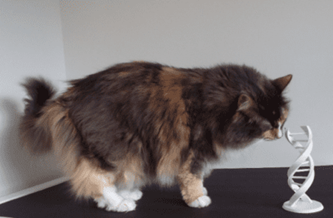
The results of the Fel d 1 PNAS Nexus paper suggest that Fel d 1 is a viable target for gene editing to develop cats that no longer produce Fel d 1. In July, InBio was granted US Patent 12,037,601 B2 for CRISPR-Cas9-mediated genomic editing of Fel d 1.

Want in? Subscribe to the InBio Newsletter stay up to date on all the latest innovations.